

Traditional Spaghetti Carbonara
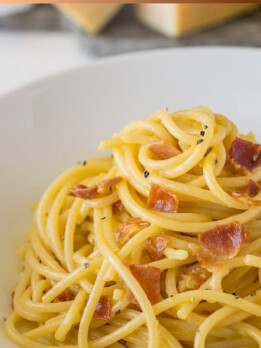
In the time it takes to boil pasta, Traditional Spaghetti Carbonara can be on the table. Although it looks rich and creamy, there’s actually no cream at all.
The sauce comes together with eggs, freshly grated Pecorino Romano cheese and crispy guanciale
(Italian salt-cured pork cheek). Quick enough for a weeknight and special enough for a cozy dinner for two, this classic Italian dish is comfort food done right.

Table of contents
Ingredients
- Spaghetti
- Egg yolks
- Pecorino Romano Cheese
- Ground black pepper
- Olive oil
- Pancetta
It’s amazing how a few simple ingredients can turn into a satisfying pasta meal.
This recipe (I first published in 2018) is made in a similar way to my Cacio e Pepe Gnocchi and follows an authentic Roman-style method. First, the guanciale (or bacon) is crisped. Then the warm – but not hot – spaghetti is tossed with a little starchy pasta water, egg yolks, and cheese to create a silky sauce.
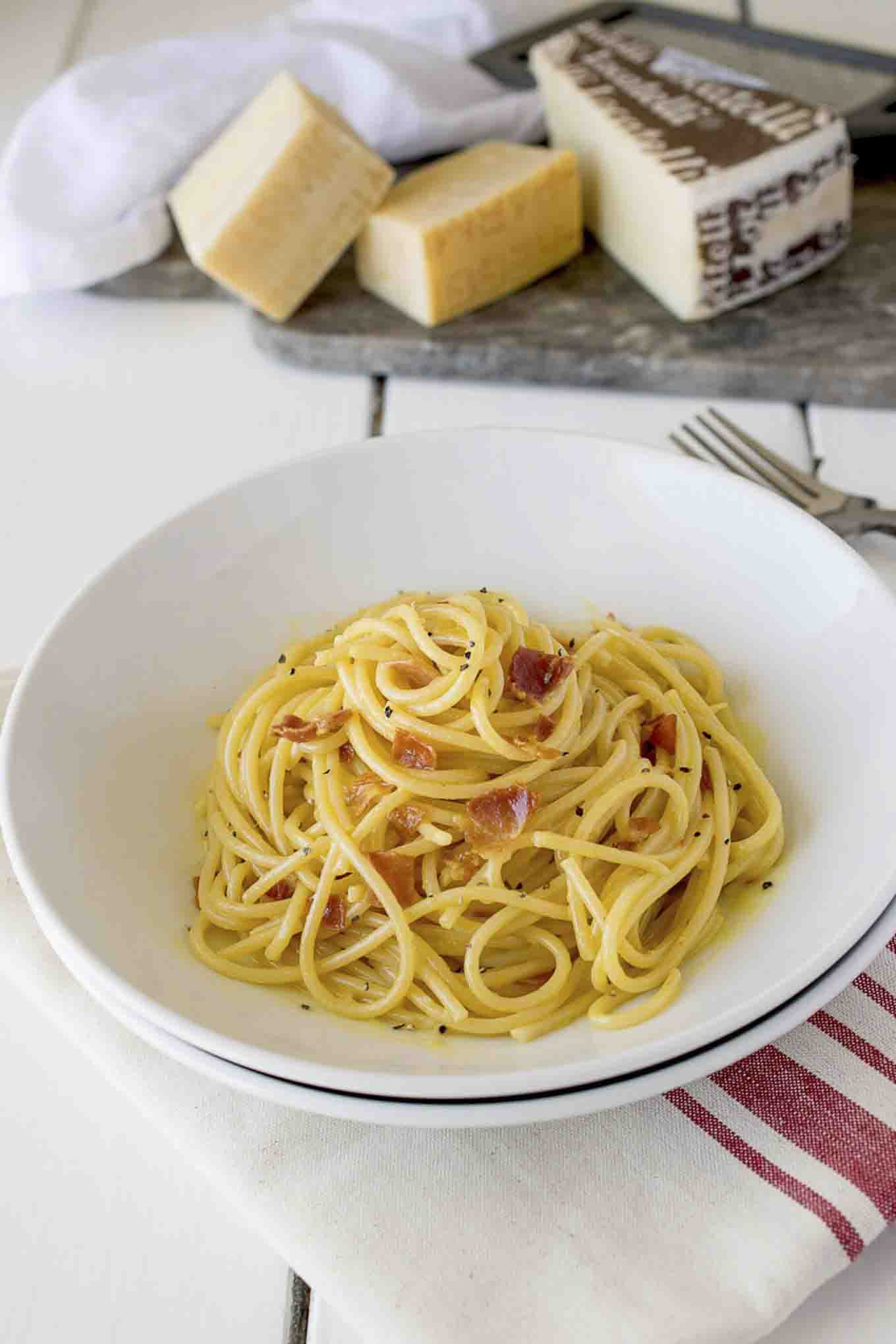
Ingredients not allowed in carbonara
There is no cream or milk in authentic carbonara sauce, even though many modern carbonara recipes include it. The creaminess comes from creating an emulsion with egg yolks and freshly grated Pecorino Romano. Timing is key – if the heat is too high, you can easily end up with scrambled eggs instead of a silky sauce.
Another Italian no-no in carbonara? Garlic.
And when it comes to substitutions, there’s really only one acceptable swap: pancetta in place of guanciale. Guanciale can be difficult to find outside of Italy, so pancetta is widely considered the best alternative.
Disclosure: Don’t come for me – these rules were set by the Roman Italians.
Carbonara ingredient breakdown
Pasta
Spaghetti is the traditional pasta used, though bucatini (hollow spaghetti) is also common. Italians are very particular about pairing the right pasta shape with the right sauce, and carbonara is no exception. Long pasta works best because it allows the silky egg and cheese sauce to coat every strand.
Just like Traditional Bolognese Sauce is not served with spaghetti but with tagliatelle, pasta shape matters in Italian cooking. The right pairing makes all the difference in texture and flavor.
Eggs
Egg yolks are key to creating that rich, creamy sauce.
Cheese
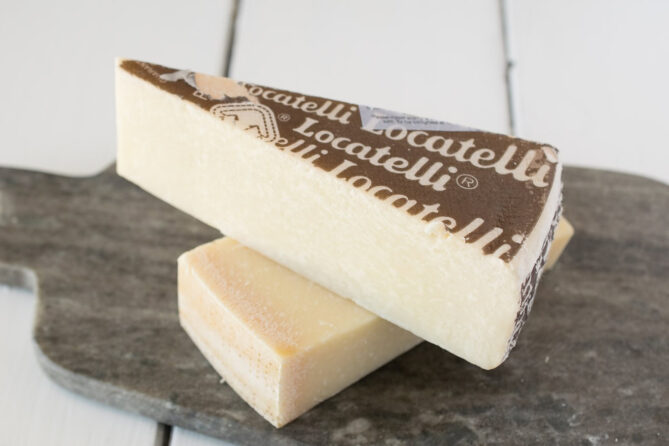
Only a little Pecorino Romano – a hard, salty Italian cheese made from sheep’s milk – is used in traditional carbonara. If you can’t find it or prefer a milder flavor, you can substitute Parmigiano Reggiano (Parmesan cheese – I won’t tell the Italians!).
Italian bacon
To make this carbonara truly authentic, guanciale (pronounced gwan-cha-lay) is traditionally used. Guanciale is Italian cured pork from the pig’s jowl (cheek), but it can be hard to find outside Italy. If you can’t get it, the next best options are pancetta or thick-cut, salt-cured, unsmoked bacon.
Salt
There’s no need to add salt to the sauce as the Pecorino Romano is already salty enough. A small pinch of freshly cracked black pepper balances the flavors perfectly.
Carbonara success checklist
Before you serve, run through this quick checklist to make sure your spaghetti carbonara turns out perfectly silky and delicious:
✔ Eggs are at room temperature
✔ Cheese is freshly grated (not pre-shredded)
✔ You reserved at least 1 cup of pasta water
✔ The pan was removed from heat before adding the egg mixture
✔ You tossed quickly and continuously
✔ You added pasta water slowly to reach that glossy, creamy texture
✔ Served immediately while hot and silky
Tips for making spaghetti carbonara
- Use Room Temperature Eggs: Cold eggs don’t blend as smoothly. Let them sit out for about 20–30 minutes before mixing with the cheese. Or place the uncracked eggs in a bowl of warm water for 5 minutes.
- Save Your Pasta Water: Before you drain the pasta, reserve at least 1 cup of the starchy cooking water. This is the key to creating that silky sauce.
- Work Off the Heat: Once the pasta is cooked al dente, remove the pan from direct heat before adding the egg and cheese mixture. This prevents scrambled eggs and keeps the sauce creamy.
- Toss Quickly: Add the egg mixture and toss right away. The heat from the pasta creates a silky, glossy sauce.
- Add Pasta Water Slowly: Stir in a little reserved pasta water at a time until the sauce becomes creamy and coats the pasta beautifully.
- Don’t Overcook the Bacon: Cook it until crispy but not hard. You want texture without it becoming too crunchy or dry.
- Use Freshly Grated Cheese: Freshly grated Pecorino Romano melts better and gives the best flavor.
- Serve Immediately: Carbonara waits for no one. It’s at its absolute best right after tossing – silky, glossy, and perfectly coated.
Leftovers
Carbonara is best enjoyed fresh, but leftovers can still be delicious. Store any remaining pasta in an airtight container in the refrigerator for up to 2 days.
How to reheat without scrambling the eggs
Reheat gently. Add the pasta to a skillet over low heat with a splash of water or milk to loosen the sauce. Stir slowly and heat just until warmed through. Avoid high heat, as it can cause the sauce to become dry or grainy. If you find that the spaghetti has absorbed the sauce, if you have more eggs and Pecorino, whisk up some more. Just make sure the spaghetti is hot pasta through (but not too hot), so it melts the Pecorino into the egg yolks.
Microwave tip: Heat in short 20–30 second bursts, stirring in between, and add a small splash of liquid if needed.
Subscribe to my newsletter below for more recipes delivered to your inbox.
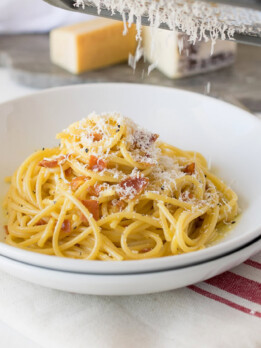
Traditional Spaghetti Carbonara

Video
Ingredients
- ½ pound (226 grams) spaghetti
- 4 large egg yolks, room temperature, Cold eggs don’t blend as smoothly. Let them sit out for about 20–30 minutes before mixing with the cheese. Or place the uncracked eggs in a bowl of warm water for 5 minutes.
- cup (83 grams) freshly grated Pecorino cheese
- ¼ teaspoon freshly ground black pepper
- 1 teaspoons olive oil
- ¾ cup (83 grams/3 ounces) guanciale (Italian salt-cured pork cheek) or pancetta, chopped
Instructions
- Bring a large pot of water to a boil. Once boiling add the spaghetti and cook according to package directions.
- While the spaghetti cooks, add the egg yolks, finely grated Pecorino Romano, and freshly cracked black pepper to a medium bowl. Whisk until well combined and set aside.
- To a sauté/frying pan over medium heat add the oil. When hot add the guanciale or pancetta or bacon and cook until crisp, turn off the heat and leave in the pan.
- When the spaghetti is cooked, reserve 1 cup of the liquid and drain.
- Add the warm spaghetti straight into the pan with the pancetta. Add a little of the reserved pasta water and the egg yolks and cheese. Toss quickly and continuously until the sauce becomes creamy and coats the spaghetti. Do not turn the heat back on — the residual heat will cook the eggs gently. Adding direct heat can scramble them.
- If the sauce is too thick, add a little of the reserved water until until silky and glossy.
- Serve warm.
I found your recipe on pineterest and made it for dinner last night. So good and so easy. I can’t wait for lunch to eat the leftovers. I am loving that shrimp pasta from the video, I think I’ll make that this weekend.
Thank you for the feedback, enjoy the leftovers.
I just received this recipe in email, i was curious about the cheese, can i use already grated parm in container from kraft? and i have some mozzarella here alrdy, and wondered can i use this instead of romano? if not i will go out to look for romano
Thank you for being a subscriber. You can use the Parmesan you have. Freshly grated is better, but since you already have it, use it. I would not use mozzarella, it is very different to Romano cheese in texture and flavor. The Romano is very similar to Parmesan and is added because it has a more tangy flavor than Parmesan. If you can’t find it, I would substitute more Parmesan for the Romano and no mozzarella. Also, if you can’t find pancetta, you can substitute bacon. Pancetta is not smoked, so bacon add a smoky flavor to the dish. Enjoy the recipe and please come back and leave a comment and a rating on the website if you get a chance.
I first had the most amazing carbonara on a trip to Rome last year. I made your recipe last night and was just as good as I had in Italy, really easy too. I’m going back to Italy this year and hope to find a carbonara just as good.
I wish I was having this today. Thank you for the feedback and you will love the linguine shrimp too 🙂
I remember reading your recipe awhile ago, had company over for dinner, and decided at the last minute to add this as an appetizer course, had to make it from scratch, forgot to look it up. so the only thing I forgot was the olive oil, and I did add 1/4 cup Italian parsley chopped up. also, I forgot to turn the heat off. the first 6 people got it perfect and creamy, me and my brother got it where it had scrambled eggs, the importance of turning that heat off. but everybody loved it. this is slightly difficult when cooking it for 8 people.
I love the idea of serving this as an appetizer. I’ve been there and eaten scrambled eggs too. I suppose it’s just part of being the cook. Thank you for leaving the comment with your input.
I took a chance and made this for my family and Italian mother in law last night. Everyone loved it, this recipe gets my MIL’s Italian seal of approval and my new quick and easy go-to dinner. Thanks.
Thank you for having confidence in my recipe to try it out on your mother in law. Phew, I’m glad it was a hit 🙂
Always enjoy seeing your posts Janelle and thanks for sharing ! Pinned
This is what I made for dinner last night! One of our family’s favorites! However, your recipe is much more authentic than mine (although, since it’s a Roman dish, using Parmigiano instead of Pecorino Romano could ignite a battle! haha!)
Although mine is very inauthentic, (I add half and half to the beaten eggs! I’m going to start WWIII by doing that!) I like it so much because of its creamy sauce. My cousin in Italy yelled at me for this! 😉
I think your friend will be very pleased with your recipe and I love your pronunciation for guanciale! PERFETTO!! 🙂
Thank you Christina for stopping by. I did use pecorino at first and it was very salty so I changed it up. Pecorino I can only take in small amounts. I can imagine your cousin would not be happy about the half and half, they’re very protective of their recipes. If I took nothing else away from my trips to Italy, I try and respect them and not butcher the language 🙂
Great recipe, as a chef, I can recognize a great recipe, I recommend that everyone try it.
Paul
This Spaghetti Carbonara recipe looks delicious. LOVE all the freshly grated cheese you put on the recipe. Nothing like a good meal enjoyed with long time friends.
I have never made spaghetti carbonara but now I cannot wait to make yours – probably tonight! Looks divine!
Thank you Jen 🙂
Love carbonara Janette and I have now put your recipe on my list to do!
I look this dish but not had it for too long. Makes a fab change from tomato or cheese pasta sauces!
Dear Janette, What a delicious meal. Carbonara is such a treat…a comforting meal. xo, Catherine
Delicious and simple recipes are the perfect comfort foods. Gorgeous photos.
This sounds so good!
This carbonara is just fantastic!! I always love this dish and your recipe sounds perfect 🙂
One of my favorite easy meals! Looks amazing!
So glad you were able so see your friend after so long! Love this carbonara and will be making it soon 🙂
Thank you so much Mira 🙂
Yum.. Inspired me to start making this again. A dish I had forgotten about but love.
I hadn’t made it in a while either, I missed it 🙂
Cabonara is such a great dish, something I normally only order at restaurants. Always loved the version at the Cheesecake Factory. Yours looks even better though; I can’t wait to try it.
So simple. So delicious. So beautiful. Lovely recipe!
One of the best pasta dishes I have tried. Great recipe, easy to follow, highly recommended.
Such a great dish. I like that you shared what a real carbonara pasta is.
This looks so fantastic Janette! I love easy dishes like a carbonara!!! Love the cheesy goodness!
One of my favorite indulgences!! Love your recipe!!
Thank you Tara 🙂