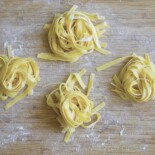
Homemade Tagliatelle Pasta
Master the art of authentic Italian pasta at home with just five simple pantry staples - flour, eggs, salt, olive oil, and water. You’ll create a silky, tender dough ready to be rolled into perfect tagliatelle.
Ingredients
- 3 cups (390 grams) all-purpose/plain flour
- 4 large eggs room temperature
- 1 teaspoon salt
- 1 tablespoons olive oil
- 2 teaspoons water
Instructions
Form the dough:
- On a clean work surface or in a large bowl, mound your flour and create a wide well in the center. Add the eggs, salt, olive oil, and water into the well. Using a fork, gently beat the eggs and begin incorporating flour from the inner rim of the mound. Use your other hand to cup the outside of the flour wall, keeping the structure intact so the liquid doesn’t escape.
Knead:
- Once the liquid is absorbed and a shaggy dough begins to form, switch to your hands. Knead the dough using the palms of your hands. Don’t force the dough to absorb every last bit of loose flour on the board; stop adding flour once the dough comes together and is no longer sticky. If it does take all the flour and still feels tacky, dust in a little more, one tablespoon at a time. Knead firmly for up to 10 minutes until the dough is smooth, soft, and elastic—this building of gluten is what makes the pasta nice and light.
Rest the Dough:
- Wrap the dough tightly in plastic wrap, ensuring no air can get in to dry it out. Let it rest on the counter for 30 minutes.
Choose Your Preferred Method:
Method 1: Using a Pasta Machine
- Prep: Cut the rested dough into quarters. Take one quarter and immediately re-wrap the remaining three so they stay moist. Shape your active piece into a rough rectangle with your hands.
- The First Roll: Set your pasta machine to its widest setting and run the dough through. Fold the dough in half and pass it through again on the same wide setting. Repeat this folding and rolling process two more times to laminate the dough.
- Roll It Thin: Turn the machine to the next narrowest setting and pass the dough through. Continue running the sheet through, decreasing the setting by one notch each time, until you reach the thinnest setting.
- Cut the Tagliatelle: Attach the tagliatelle cutter to your machine and run the pasta sheet through one last time. Gently drape the cut strands over your hand, transfer them to a floured board or baking sheet, and let them dry for 30 minutes. (A pasta drying rack works beautifully here, too!)
Method 2: Rolling by Hand (No Equipment Needed)
- Roll: Work with a small portion of dough at a time on a well-floured surface. Use a rolling pin to roll it out as thin as possible, aiming for a rectangle roughly 6x12 inches (15x30 cm).
- Fold: Generously dust the top of the dough with flour. Starting from the short end closest to you, loosely roll the dough up into a flat, wide cylinder.
- Slice: Using a sharp chef's knife, slice the log crosswise into ribbons. For traditional tagliatelle, cut them about 3/16-inch (5 mm) wide. Gently unravel the sliced ribbons with your fingers and toss with a little extra flour.
Storing Fresh Pasta:
- While fresh pasta is best cooked right away, you can easily save it for later using these two simple methods:
- In the Fridge (Short-Term): Form the fresh strands into loose, single-serving nests and toss them with a little extra flour or semolina to prevent sticking. Place them in a single layer inside an airtight container and refrigerate for up to 24 hours.
- In the Freezer (Long-Term): This is the best way to preserve that fresh-made quality! Portion the pasta into nests, place them on a baking sheet, and freeze for 15 minutes until firm. Transfer the frozen nests into individual freezer bags and store for up to 3 months.
Cooking tip: When you're ready to eat, there is no need to thaw! Drop the frozen pasta straight into a pot of salted boiling water. It will cook in just a few minutes and is ready to remove once it floats to the top.
Nutrition
Serving: 1 | Calories: 279kcal | Carbohydrates: 47g | Protein: 9g | Saturated Fat: 1g | Cholesterol: 81mg | Sodium: 420mg | Fiber: 1g