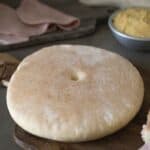
Traditional Stottie Recipe
A round flat yeast bread from the North East of England.
Ingredients
- ½ cup (150 ml) whole/full milk warmed to 105-110°F/40-43°C
- ½ cup (150 ml) water warmed to 105-110°F/40-43°C
- 1 teaspoon granulated sugar
- 1 tablespoon (14 grams) melted lard, or vegetable oil
- 2 teaspoons (8 grams) dry fast acting instant yeast
- 2 cups (453 grams) bread flour/strong flour see note
- 1 teaspoon salt
Instructions
- To a large mixing bowl, add the milk, water, sugar, lard or oil and yeast; mix well. Sprinkle the yeast on top and leave to dissolve. Once dissolved, stir to combine and leave for 10 minutes.
- To the yeast mix, add half the flour and stir to combine. Stir in the rest of the flour and the salt. Mix until all the liquid is incorporated into the flour. Turn out onto your surface (it may be crumbly) and start kneading to incorporate the flour (don’t add more flour). Knead the dough for at least 8 minutes until it is smooth.
- Clean out the mixing bowl and rub with a little oil and place the kneaded dough inside. Cover the bowl tightly with plastic wrap and let rise at room temperature (in a warm draft free area) for about 1 hour until doubled in size.
- Once the dough has doubled in size, punch it down to expel the gas and turn out onto your surface. There should be no need to add flour, you want it soft and smooth.
- Cut the dough in half and form into flat rounds using your hands and a rolling pin, about 8-inches (20 cm). Place on a lightly oiled baking sheet, cover and let sit for 10 minutes.
- Preheat oven to 350°F/180°C and place the rack in the lower 3rd of the oven.
- Use your finger to push a dimple into the center (all the way to the bottom). Some people also poke holes all over the top with a fork (you can do one, both or neither) and sprinkle a very light coating of flour over the loaf.
- Bake for 8 minutes, then rotate the pan 180 degrees and bake for a further 6-8 minutes until lightly golden on top. Please remember: the time may vary depending on your oven.
- When done, remove and place on a cooling rack to cool. Cover lightly with a towel, this will help keep the steam in and keep the bread moist as it cools.
Video
Notes
* Flour is more accurate when weighed, this is approximately 3 5/8 cups
Nutrition
Serving: 1 | Calories: 234kcal | Carbohydrates: 43g | Protein: 8g | Fat: 3g | Saturated Fat: 1g | Polyunsaturated Fat: 2g | Cholesterol: 2mg | Sodium: 273mg | Fiber: 2g | Sugar: 1g