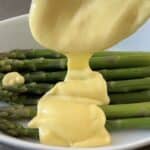
The Easiest Hollandaise Sauce
Just a few steps and some key tips for making the perfect hollandaise sauce.
Ingredients
- 2 large egg yolks
- 2 tablespoons cold water
- 1 ½ cups (330 grams) clarified butter/ghee or unsalted butter, melted and kept warm * see note
- Fresh lemon juice to taste
- Salt to taste
- Cayenne pepper optional
Instructions
- Collect your equipment needed. A large pot, a stainless steel or glass bowl that fits snuggly inside the pot so steam doesn’t escape and is deep enough so when you add water it does not touch the bottom of the bowl, and a whisk.
- Fill the pot with a few inches of water and bring just to a simmer. To the bowl (off the heat) add the egg yolks and cold water. Whisk vigorously until the mix is pale in color and tripled in volume, if you don’t whisk hard enough the sauce can be heavy. This should happen in just under a minute if whisking hard enough. This is now a sabayon.
- Place sabayon bowl over the pan of water whisking vigorously and continuously trying to not splash egg up the sides as it will quickly overcook. If egg on the side of the bowl starts to cook remove bowl and whisk off the heat. The bowl will retain plenty of heat and heat the yolks to a high enough temperature so they properly thicken but not so high that they overcook
- If undercooked, the sabayon will be runny have an overly eggy flavor and potentially cause the sauce to split If overcooked and yolks begin to look scrambled or curdle like video need to start over. Do not add butter to overcooked eggs as they’ve lost their ability to emulsify the sauce.
- If the sabayon is right, remove it from the heat (if it is not already) and whisk for 20 more seconds to prevent overcooking from the bowls residual heat. This stage of the sauce is done when it suspends on the whisk without dripping doubled in volume, thick and creamy. If it is looking scrambled and curdled, you will need to start over.
- Empty the water from the pan that was used to make the first part of the sauce. Cover the pan with a damp cloth. You’re going to be using this to secure the bowl while whisking in the butter. The residual heat from the pan will keep the sauce warm as you add the butter. Place the bowl back on the pan with the cloth.
- Starting whisking and slowly drizzle in the butter using a ladle while whisking. Don’t take too long to add the butter as you can overwork the sauce and will cool down too much and lose it’s air, but don’t add to quickly or it will split. As soon as you see the butter disappear into the sauce it’s safe to add more. Make sure you don’t whisk too much in between additions of butter this will cause the sauce to cool down too much. As butter is added to can see how the sauce begins to thicken.
- When the sauce is relatively thick, this is a good stage to stop adding butter (you will be adding liquid at the end). Don’t make it too thick or you will end up with mayonnaise. Do not incorporate any dried bits that are stuck to the sides of the bowl as this will add lumps to the sauce.
- If you start to see lines of butter on the surface of the sauce, this could cause the sauce to split. You can whisk in a few drops of water and whisk, this will help keep it stable. You should have used about 1 cup of butter at this stage.
- If the sauce goes quickly from thick to thin, it means you have added too much butter and will look grainy, this means it is broken.
- The consistency you are looking for is thick, but still able to pour off a spoon.
- Whisk in enough lemon juice (a little at a time) to your taste. If you add too much lemon, add a little more butter to mellow the flavor. If too thick, you can add a little water to thin out, just be careful to not add to much.
- When done, the sauce should be pale yellow and have a nice sheen. It should be thick, airy and pourable off a spoon. Season with salt to taste. You can add pinch of cayenne pepper if you like. If too thick, you can add a little water while whisking. If too thin, it could be to warm and it will thicken a little as it cools.
Video
Notes
You may need less depending on how quickly the sauce thickens
To keep the butter melted and warm, you can keep it over very low heat, or place in a bowl inside a larger bowl of warm water.
To keep the butter melted and warm, you can keep it over very low heat, or place in a bowl inside a larger bowl of warm water.
Nutrition
Serving: 1 | Calories: 483kcal | Protein: 3g | Fat: 53g | Saturated Fat: 33g | Polyunsaturated Fat: 18g | Cholesterol: 224mg | Sodium: 123mg